
Motec® Wrist Replacement
A guide for patients considering or recovering from wrist replacement surgery
This leaflet is for general information. Your surgeon and hand therapist will give you advice specific to your wrist, your operation and your recovery.
Why might I need a wrist replacement?
The wrist is made up of several small bones and joints that work together to allow your hand to move.
Damage to these joints can cause persistent:
- Pain
- Stiffness
- Swelling
- Weakness
- Reduced movement
- Difficulty using the hand for everyday tasks
Wrist damage can occur because of arthritis or previous injury.
If other treatments have not provided enough relief, your wrist specialist may discuss total wrist replacement with you. The decision depends on your symptoms, examination, X-rays and the demands you place on your wrist.
Other treatments may be available, including continued non-operative treatment or a wrist fusion. Your surgeon will discuss the alternatives that are appropriate for you.
What is a Motec® wrist replacement?
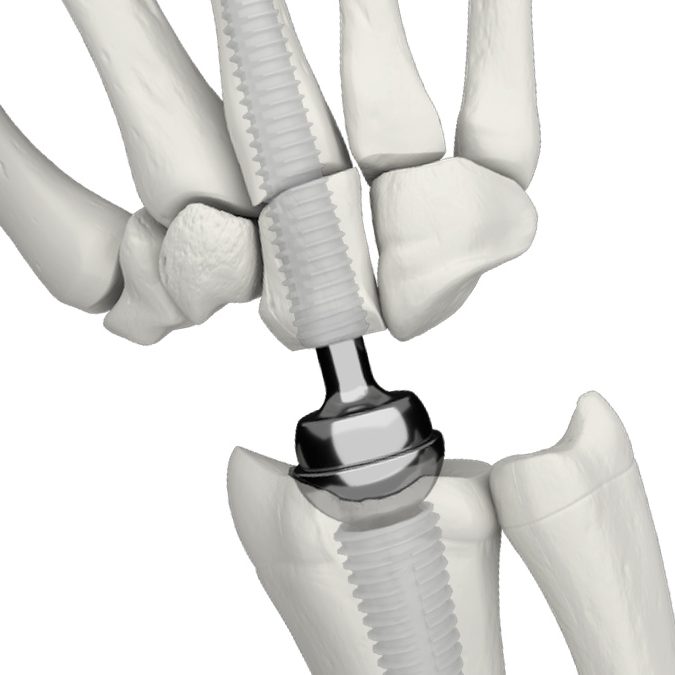
A Motec® wrist replacement is an artificial joint designed to replace the damaged parts of the wrist.
The system uses a ball-and-socket design. Components are fixed into the radius (one of the forearm bones) and bones on the hand side of the wrist. The components have surfaces designed to encourage bone growth onto the implant, so bone cement is not usually required.
The Motec® system is designed to provide a combination of pain relief and useful wrist movement. Its design also permits a movement known as dart-thrower's motion, which is involved in many everyday hand and wrist activities.
Who may be suitable?
Motec® wrist replacement can be considered for adults whose wrist has become painful, unstable or poorly aligned.
Conditions for which the Motec® system may be considered include:
- Osteoarthritis
- Arthritis following injury
- Rheumatoid arthritis
- Kienböck's disease (avascular necrosis)
- Certain wrist problems following previous surgery
Being diagnosed with one of these conditions does not automatically mean that wrist replacement is the right treatment. Your surgeon will assess your individual circumstances.
What is the aim of surgery?
The operation aims to give you a wrist that is:
- Less painful
- Stable enough for everyday use
- Able to retain useful movement
A wrist replacement is not designed to reproduce a completely normal wrist. Your final movement and strength will depend on factors such as your underlying condition, previous operations, bone and soft-tissue condition and rehabilitation.
NICE advises that patients considering total wrist replacement should be informed about the possible benefits, risks, alternatives and the possibility that further surgery may eventually be required.
Results vary between patients. Surgery cannot guarantee complete pain relief or normal movement.
What should I expect from my new wrist?
It is helpful to have realistic expectations.
A successful wrist replacement should aim to give you less pain and useful movement, rather than a completely normal wrist.
You may still have:
- Some stiffness
- Reduced strength
- Restrictions on heavy activities
- Some discomfort with demanding tasks
The amount of movement you achieve cannot be predicted precisely before surgery.
Your surgeon and therapist will help you understand what is realistic for your wrist.
Wrist replacement or wrist fusion?
A wrist fusion is an alternative operation for some people with severe wrist arthritis.
The important difference is that:
Wrist replacement aims to reduce pain while retaining some wrist movement.
Wrist fusion aims to provide a solid, stable and usually pain-relieving wrist, but the wrist joint itself no longer moves.
The most appropriate operation depends on your wrist, your condition and the activities you need to perform. Your surgeon will discuss the alternatives with you.
What happens during the operation?
The operation is carried out under general (completely asleep) or regional anaesthesia (numbed arm).
Your surgeon accesses the wrist and prepares the joint using an incision over the back of the wrist. Sometimes addition incisions are needed. The artificial components are then positioned in the appropriate bones and checked for satisfactory movement and stability.
The precise surgical technique varies between patients and depends on the condition and anatomy of your wrist.
What are the possible risks?
Every operation has risks. Your surgeon will discuss these with you before surgery.
Possible complications of wrist replacement include:
- Infection
- Bleeding or wound problems
- Persistent pain
- Stiffness
- Reduced wrist movement
- Nerve or tendon problems
- Instability or dislocation
- Loosening of an implant
- Wear or failure of the implant
- Fracture around the implant
- Problems with bone healing or fixation
- The need for further surgery
- Complex regional pain syndrome
Other complications can occur because of the anaesthetic or because of your individual medical conditions.
NICE identifies infection, dislocation, loosening, stiffness and nerve/vessel damage complications among the important potential complications of total wrist replacement.
How long will my wrist replacement last?
It is not possible to give an exact lifespan for an individual wrist replacement.
The longevity of the implant can be affected by factors including:
- Your age
- Bone quality
- Your underlying condition
- Previous wrist surgery
- The amount and type of loading placed on the wrist
- The condition and fixation of the implant
Your surgeon will discuss what this means for you.
Motec wrist replacement has demonstrated an 86% implant survival at 10 years, and has an ODEP rating of 3A or 7B depending on the chosen implant surfaces.
Regular clinical follow-up may be recommended so that the condition of the replacement can be monitored.
Could I need another operation?
Yes. Occasionally a wrist replacement may require further surgery. This may be for a problem related to the implant, or for another condition in the same area.
The Motec® system has a specifically designed arthrodesis (wrist fusion) system that can be used if conversion from a Motec® wrist replacement to a total wrist fusion.
This does not mean that you will require a fusion. It is one possible treatment option if a replacement cannot continue to provide satisfactory function.
What happens after surgery?
Your wrist will normally be protected in a cast for 2-3 weeks after surgery and a sling will be issued to help keep the hand elevated.
Your hand will become be very swollen and uncomfortable. Keeping the hand raised helps reduce this.
Instructions:
- Looking after your wound – the hand must be kept elevated, and completely clean and dry until the cast is removed and the wound has healed (2-3 weeks usually)
- Moving your fingers – gentle finger movement is encouraged immediately to avoid stiffness
- Protecting the wrist – No load is to be put through the hand/wrist for 6 weeks following surgery. A gradual return to full activity can then be made over the next 6 weeks. No restrictions from 12 weeks.
- Wearing your splint – A splint will be fitted following cast removal. This can be removed for hygiene and gentle movement exercises. The splint should be discarded between week 6 and 12.
- Pain relief – Prescription pain relief will be provided following surgery. It is advisable to start taking this before the anaesthetic has worn off. It is typical for prescription pain killers to be needed in the first week of so after your operation. Intermittent use of simple pain killers may be needed for a few months as you adjust to your new wrist.
- Exercises – These will be guided by your surgeon and hand therapist.
- Follow-up appointments – a wound check at 2-3 weeks. Then follow-up with XRs would typically follow a pattern of 6 weeks, 12 weeks and 6 months.
Your individual instructions take priority over general information in this page.
Rehabilitation
Rehabilitation is an important part of recovery.
A hand therapist may help you gradually restore:
- Finger and thumb movement
- Forearm movement
- Wrist movement
- Strength
- Coordination
- Everyday hand function
Your exercises will normally become more demanding as your wrist heals.
Do not increase the amount of activity or resistance exercises unless your surgical or therapy team has advised that it is safe.
Everyone is different. Your own rehabilitation programme may differ.
What can I do with my wrist afterwards?
The aim of surgery is to allow you to use your hand as fully as possible.
However, a replacement wrist needs to be protected from excessive load, especially heavy impacts or vibration forces.
To ensure a good lifespan from your wrist replacement you should avoid activities involving:
- Very heavy lifting
- Heavy manual work
- High-impact sports
- Repeated impact through the wrist e,g, hammering
- Vibrating power tools
Your own team can advise you about specific activities that are important to you.
When can I return to everyday activities?
Recovery takes many months, and progress may continue to be seen over 1-2 years following surgery. Return to full strength and heavier activities will take a long time.
Return to function begins at 6 weeks following surgery. Initially, you will be restricted to light activities while your wrist is protected.
As healing progresses, your therapist will help you increase your use of the hand.
Many patients gradually resume normal daily activities over the first 6-12 weeks, but activities requiring greater strength or loading will take longer.
Do not use a particular time period as a target unless your own clinical team has advised it is appropriate for you.
When can I drive?
You should only return to driving when:
- You can safely control the vehicle
- You can comfortably operate the controls
- You can perform an emergency manoeuvre
- Your splint or other treatment does not prevent safe driving
- You should also check with your motor insurer.
- 6-12 weeks is typical but not a universal rule.
When can I return to work?
This depends on your occupation.
Someone with a desk-based job will likely be able to return earlier than someone whose work involves manual tasks.
Your surgeon or hand therapist can advise you about a realistic return-to-work plan.
What should I do if I fall or injure my wrist?
If you have a significant injury involving your operated wrist, attend your local emergency department.
If you have a concern that is not an emergency then contact your surgeon or hand therapist for advice.
When should I contact the hospital?
If you are seriously unwell or have an emergency, seek immediate medical attention via an NHS hospital emergency department.
Contact your surgeon or hand therapist if you are well but experiencing:
- Increasing rather than improving pain
- Increasing redness or swelling
- Fluid or pus from the wound
- Fever or feeling unwell
- New or worsening numbness
- New weakness
- A sudden change in the position or movement of your wrist
- Problems with your splint or wound
Questions you may want to ask your surgeon
Before making your decision, you may find it helpful to ask:
- Why do you recommend wrist replacement for me?
- What alternatives are available?
- What are the likely benefits in my case?
- What are the main risks for me?
- How much movement might I expect?
- How much strength might I regain?
- Which activities will I need to avoid?
- How long might I need a splint?
- How long will I need hand therapy?
- When might I return to work?
- When might I drive?
- What happens if the replacement fails?
- How will my wrist be monitored after surgery?